

Fish Food: Episode 617
Oscillation and leading people through change, agencies and growth, Anthropic's AI agent, community-based marketing, and can AI really help us learn?

This week’s provocation: Oscillation, and leading people through change
When it comes to managing the people side of change, we often turn to established psychological models to guide us. The Kubler-Ross ‘Five Stages of Grief’ model has become one of the most referenced frameworks not just in a personal transformation context but also in organisational change.
Kubler-Ross’s Five Stages (denial, anger, bargaining, depression, acceptance) were originally developed to explain how individuals come to terms with terminal illness or the impending loss of a loved one. Over time however, these stages have been generalised to a range of contexts including organizational change.

And therein perhaps, lies the problem. Organisation change is not the same as personal grief. As Carla Faria recently pointed out, applying a simplified model like Kubler-Ross to complex, ongoing change environments means that we run into a number of challenges.
The problem with using Kubler-Ross in change management
One of the issues I’ve long had with the application of the Kubler-Ross model to organisational change is that it presents a linear process. People move through each stage, from denial to acceptance, in a progressive manner. Yet, in reality, we know that people don’t experience change in such a neat, ordered way. Change is messy, not linear. Individuals may revisit emotions or skip stages altogether. So the model feels just too, well, neat.
Carla talks about her own experience of grief as feeling a lot more chaotic. Similarly my experience of organisational change and people’s response to it is that it is far from a linear process. Emotions fluctuate. The ebb and flow of feelings and responses do not follow a rigid sequence as situations and environments evolve. And people still need to function at work even though they may be feeling overwhelmed or worried or distracted.
The Dual Process Model
In her post, Carla mentioned Stroebe and Schut’s Dual Process Model of Grief which does a much better job at representing this ebb and flow of emotions. It’s a more dynamic, human-centered way of understanding how people cope with major disruptions, including organizational change.
The model focuses around two key dimensions: loss orientation and restoration orientation.
Loss Orientation: This is when an individual is directly processing the emotional impact of change, much like Kubler-Ross’s stages of grief. People experience denial, anger, and sadness as they come to terms with what has changed.
Restoration Orientation: In this mode, individuals focus on the practical aspects of moving forward. This might mean learning new skills, adapting to new roles, or problem-solving in a changing environment.
What makes the Dual Process Model so compelling is that it acknowledges that people oscillate between these two modes.
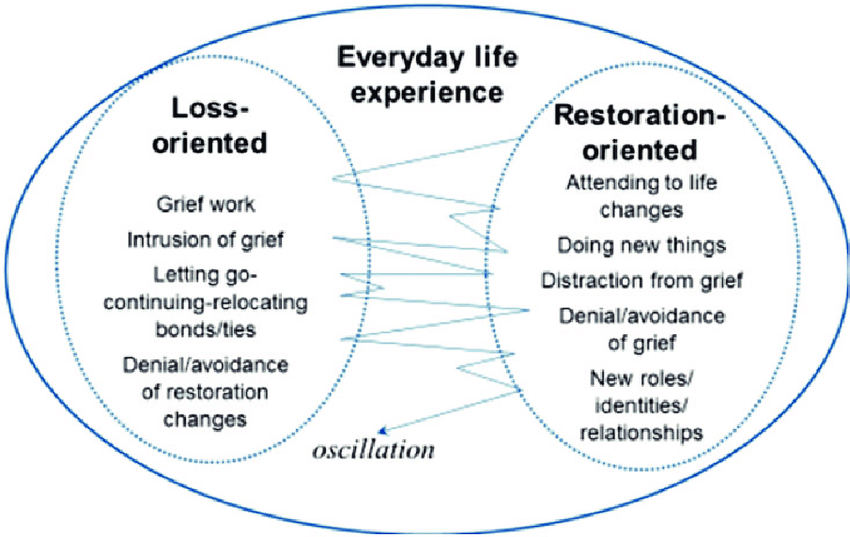
This oscillation and duality, as people move back and forth between processing their feelings and dealing with the demands of their new reality, is a far more realistic reflection of how individuals cope with the complexities of organizational change.
Rather than presenting a rigid sequence of emotional states, it accepts that people will fluctuate between struggle and adaptation, often in unpredictable ways. Anger one day, acceptance the next, a return to frustration the day after. It reflects that employees must keep moving forward, even as they grapple with uncertainty. It’s useful in the context of managing and responding to continuous change and the need to constantly adjust to new conditions. It mirrors the messiness and the reality of change.
Images: By Saurmandal - Own work based on: Kübler Ross's stages of grief.png by Timpo, CC0
The Dual Process Model of Coping with Bereavement Stroebe & Schut (1999), Creative Commons
If you do one thing this week…
The latest episode of Google Firestarters is now out, featuring the brilliant Robin Bonn, CEO of Co:Definery, talking about how agencies can drive growth. It's a time of big change for agencies, and here Robin delivers a masterclass on how agencies can differentiate themselves, write their own story and create a 'market of one'. We talked remuneration models, innovation, paying for strategy, whether agencies should be more like management consultancies, brand-led transformation, and how to push back on clients. Full of smart thinking about the future of agencies. YouTube, Spotify, Apple.
Links of the week
‘We're trying something fundamentally new. Instead of making specific tools to help Claude complete individual tasks, we're teaching it general computer skills—allowing it to use a wide range of standard tools and software programs designed for people’. Crikey. Anthropic have just released a new model (Claude 3.5 Sonnet) which will include the ability for developers to direct the AI to use computers the way people do (looking at a screen, moving a cursor, clicking, opening up apps and using them, and typing text). ‘We encourage exploration with low-risk tasks’ they say. Azeem Azhar says it’s like having an ‘AI intern’ in your pocket and his post features a couple of videos showing what the model is capable of
What’s the difference between an AI agent and a chatbot? The terms are often used interchangeably but there is a key difference between them. Where a chatbot is primarily designed to engage through conversation, an AI agent is a more sophisticated, autonomous system that can perform tasks or make decisions based on the input it receives. It often interacts with multiple systems, collects data from various sources, and can take actions without continuous human guidance. As Ethan Mollick notes, although far from perfect this Anthropic model is a not insignificant step towards having genuine AI agents.
Speaking of Claude, there were some interesting practical use cases here for using GenAI tools from an Anthropic staffer, including learning a language, and some useful editing tips (HT Ian Leslie)
And speaking of AI tools, this week I wrote about some interesting research questioning whether AI tools can actually help us to learn
Adobe has extended its Firefly image generation product into video (with rights clearance as well). The image rotation tool is pretty neat. (HT Benedict Evans)
The latest Global Digital Reports update is a hugely detailed stats dump with just about any stat you need on digital and internet platform usage around the world
A great 101 this, on community-based marketing from (friend of ODF) Michelle Goodall
I found this Radio 4 programme featuring stories about what Blur's 1999 song 'Tender' means to people hugely moving
Quote of the week
“If you give a good idea to a mediocre team, they will screw it up. If you give a mediocre idea to a brilliant team, they will either fix it or throw it away and come up with something better.” Co-founder of Pixar Ed Catmull and Amy Wallace, Creativity Inc (HT Om Malik)
And finally…
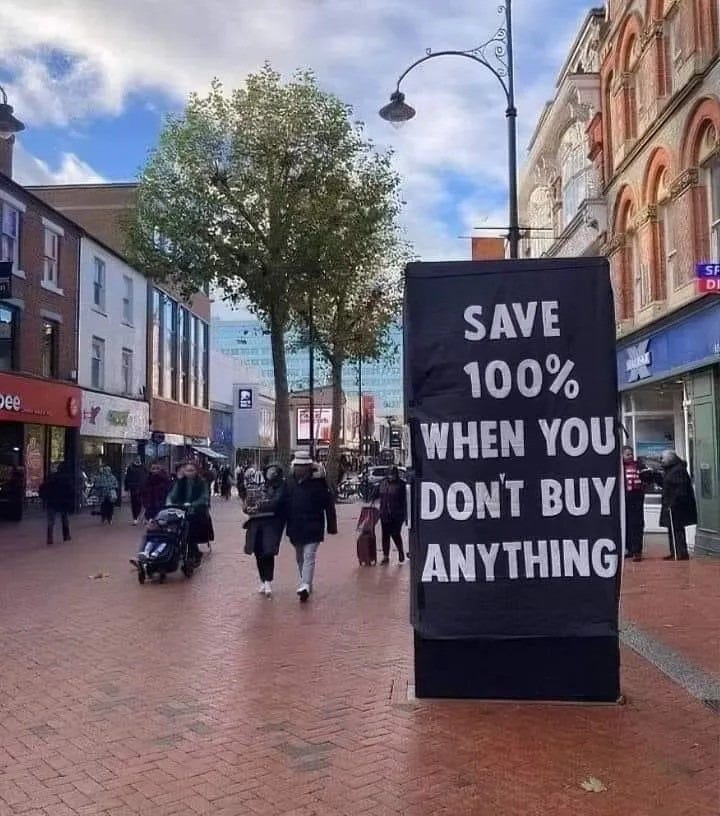
I rather liked this poster (HT Svyatoslav Biryulin)
Weeknotes
This week I was up near Derby working with the senior leadership team at my client Riviera Travel focusing on digital and agile innovation and mindsets. The nearest train station to where I was is right next door to Ratcliffe-on-Soar, the UK's last coal-fired power station which closed down a few weeks ago ending Britain's 142-year reliance on coal. The site is going to be redeveloped as a zero-carbon technology and energy hub which is great. But oh, those cooling towers…

Thanks for subscribing to and reading Only Dead Fish. It means a lot. If you liked this episode please do like, share and pass it on. If you’d like more from me my blog is over here and my personal site is here, and do get in touch if you’d like me to give a talk to your team or talk about working together.
My favourite quote captures what I try to do every day, and it’s from renowned Creative Director Paul Arden: ‘Do not covet your ideas. Give away all you know, and more will come back to you’.