

Fish Food 693: Technology, inflection points and cascading impacts
Frozen accidents, Magnifica Humanitas, preparing for a two-track internet, why it's hard to predict the impact of AI on jobs, and 21 McKinsey-style strategy Skills for Claude

This week’s provocation: Frozen accidents and the ‘goldilocks zone’
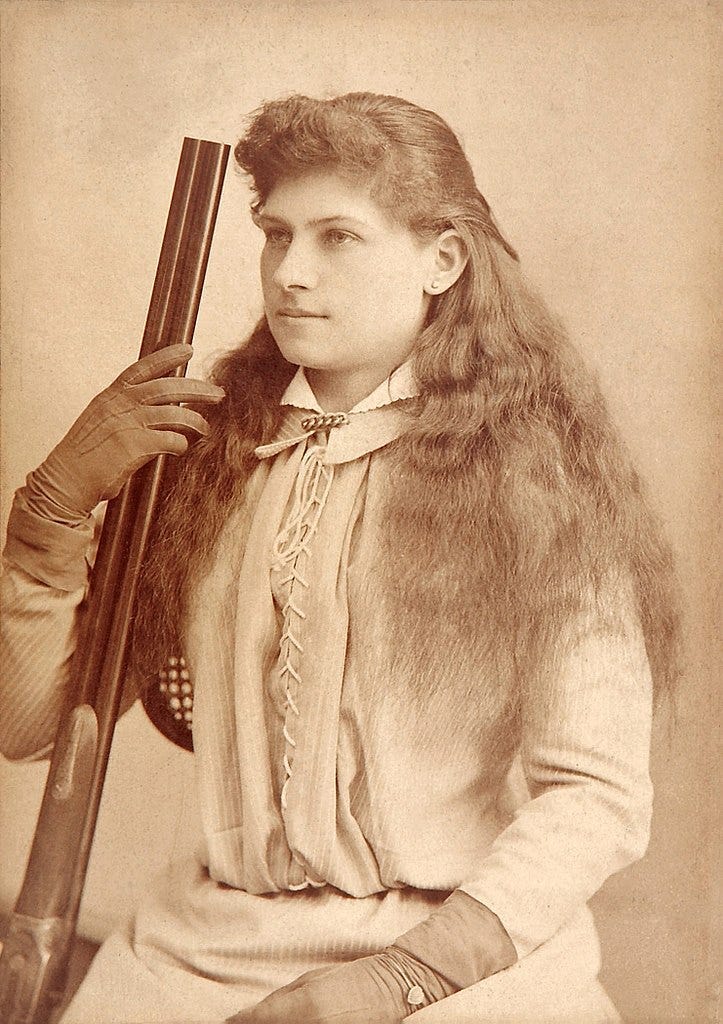
In the late 19th Century sharpshooter Annie Oakley was one of the most popular acts within Buffalo Bill’s Wild West Show. Annie would demonstrate her skills performing tricks like shooting the flames off candles and her grand finale, shooting the end off a lit cigarette held in the mouth of a brave volunteer from the audience. No-one from the audience would ever step forwards for the final trick (understandably) so Annie would plant her husband Frank in the audience who would then volunteer. But when the show was touring Europe in 1880 the young crown prince Wilhelm (who would later become Kaiser Wilhelm of Germany) happened to be in the audience for one of the shows and much to Annie’s surprise stepped forward into the ring for her grand finale trick. Annie, who was slightly unnerved by this development, had been up late the previous night in the local beer garden. She lined up the cigarette in her sights, gently squeezed the trigger…and shot the end clean off.
Many people have speculated how a slight tremor in Annie’s hand in that moment might have changed the entire course of 20th Century world history. If Willhelm had not survived perhaps World War One would never have happened, thereby saving millions of lives. Perhaps then the Communists might never have been able to overthrow the Russian government. Perhaps years later the Nazis would not have come to power following the German defeat in the first World War. Whilst this is all based on speculation, it’s not hard to appreciate how moments which look trivial in the instant can cascade for a century.
In his book The Origin of Wealth Eric Beinhocker talks about the idea of ‘frozen accidents’, or arbitrary decisions that seem inconsequential at the time but which become an irreversible foundation for the future. He gives the example of how Bill Gates and Microsoft created their first operating system. When IBM approached Gates and his co-founder Paul Allen in 1980 and asked them to recommend an operating system for their new PC, Gates’ initial suggestion was the Digital Research OS. When that didn’t work out IBM asked Gates if he’d be interested in creating it himself. Gates, who had never written an OS before, said yes and then licensed Q-DOS (Quick and Dirty Operating System) from Seattle Computer Products for $50,000, wrote a few modifications and then relicensed it to IBM as PC-DOS. In the final negotiations for the contract, and almost on a whim, Gates asked for one small change - to retain the rights to sell his DOS on non-IBM machines as MS-DOS. IBM, who were primarily focused on hardware at the time, agreed. The implications of that decision would echo through the next four decades and Microsoft now has a market cap of over three trillion dollars.
So was Gates lucky, or did he make his own luck? Dr Richard Wiseman’s work on lucky and unlucky people, suggests luck is largely a function of attention and network exposure. Lucky people notice more, talk to more strangers, and stay open to tangents. And there’s a lesson in that for all of us.
These frozen accidents or inflection points are invisible to us in the moment, and only resolve into full significance with the unfolding of time. They reveal the fantasy of perfect foresight. Frozen accidents are a bit like physicist Per Bak’s concept of Self-organised criticality. We can drop sand grain by grain and most additions to the sandpile do nothing until one identical grain triggers an avalanche. The system accumulates tension invisibly but we can’t predict which grain will be the decisive one.
In my talk on ‘What the Victorians Knew About AI’ at the Watch Me Think conference a few weeks back I used the example of the typewriter to show how early decisions around new technology can establish norms that then become difficult to change. The first typewriters had a keyboard that was designed alphabetically – two rows of letters arranged as A, B, C, D, E. But as typists got faster, the mechanical keys often jammed. So in 1873 Christopher Sholes redesigned the layout to deliberately slow people down. He scattered the common letters across the keyboard, called it QWERTY, and the QWERTY keyboard rapidly became the default. More ergonomic alternative designs came along later (including the Dvorak layout in the 1930s) but by then millions of people had already learned to type on a QWERTY keyboard. And as word processors, computers, phones were produced the switching costs got higher and higher and a hundred and fifty years later, we are still typing on a keyboard that was actually designed to be less efficient.
Small, almost arbitrary early choices can lock in disproportionate long-term consequences. Switching costs compound silently, so the cost of a default isn't visible at the moment you adopt it, only later when you try to leave. But frozen accidents in technology aren't inherently bad. In the 1970s, when researchers were working out how to get computer networks to talk to each other, Vint Cerf and Bob Kahn developed a set of protocols called TCP/IP. Plenty of rival schemes existed but, less through grand design than through rough consensus and the fact that it happened to work, TCP/IP went on to become the foundation for the entire internet.
Yet where QWERTY locked us into a constraint, TCP/IP did the opposite. Since the protocols were open and deliberately undemanding about what ran on top of them, anyone could build almost anything without asking permission, from the web to email and everything that followed. The accident that froze was one that left the maximum room to move. And that, it turns out, is the distinction we should be paying attention to. It’s less a question of whether something becomes locked in and more a question of whether you are then locked into something that preserves or erodes your optionality. And TCP/IP is a great example of a standard that preserved optionality.
With AI, no-one can effectively predict now which model will win out, how it will ultimately be integrated into systems, how organisations will end up architecting knowledge, its impact on jobs, or what defaults around usage will develop. Making big bets in such an unpredictable environment is high risk, and yet right now there are many decisions being made by individuals and organisations that are generating rigidity when the one thing we’re likely to need with such uncertainty is flexibility.
Decisions like committing to a single foundation model or vendor, where the potential lock-in isn't just the model itself, but everything that’s built specifically around its distinctive quirks. Or standardising prematurely around a single internal tool or interface and mandating a company-wide AI assistant or agentic tool without allowing for sensible exceptions or additions. Or hard-coding your process and org design around today’s model capabilities when the capability frontier is moving so fast. Or setting rigid governance and policy written for a moment in time, and then failing to adapt them to allow for the adoption of better, safer approaches later.
Scott Brinker, who is IMHO consistently one of the most insightful voices on marketing technology (and a friend of ODF), once coined the phrase the ‘goldilocks zone’ to describe a sensible approach to technology investment. New technologies, he said, are emerging and progressing through the ‘hype cycle’ faster than ever, meaning that both over-investment/over-commitment in the early stages and under-investment/under-commitment in the ‘trough of disillusionment’ phase can create problems. The ‘goldilocks zone’ is not too much, not too little, but just enough.
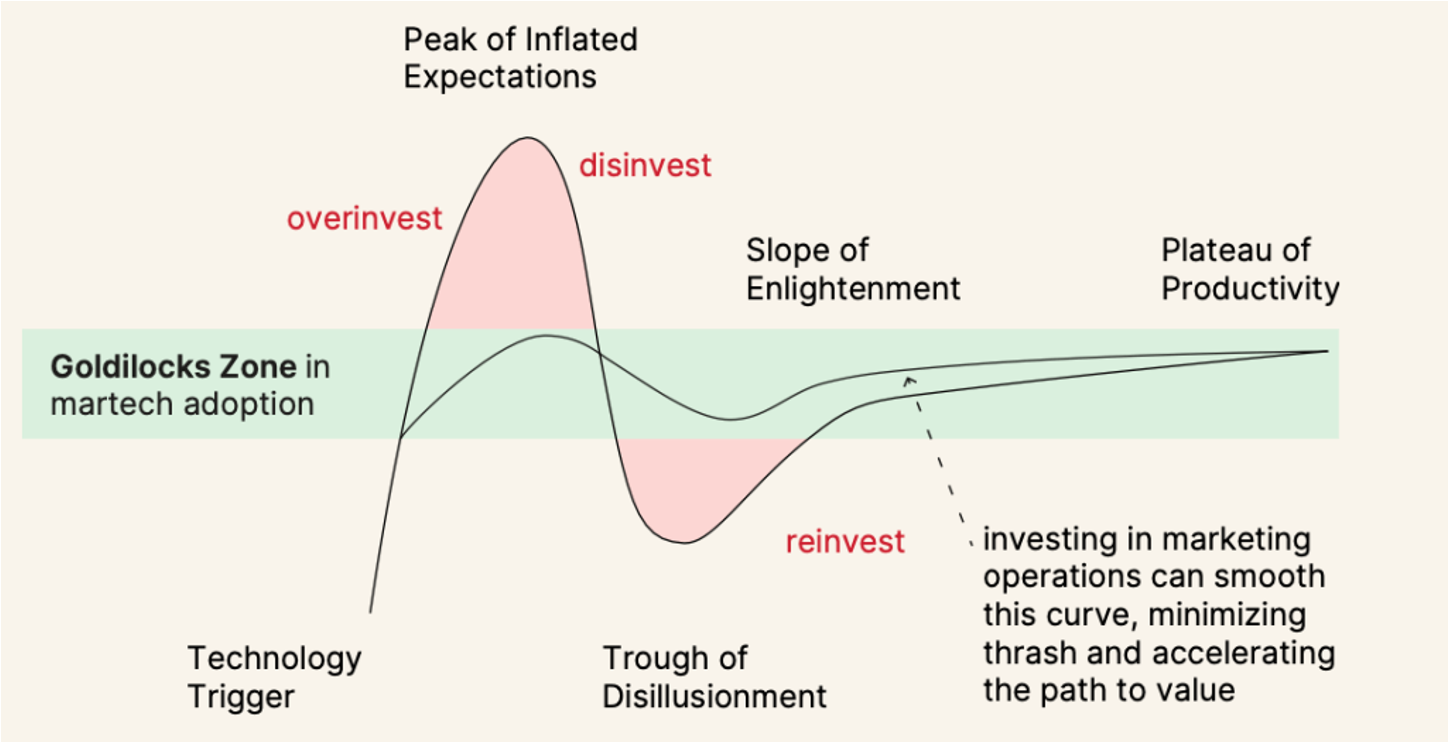
This is not an appeal for businesses to stop investing in AI (many seem to be moving too slowly as it is), but rather a plea to retain optionality. It’s less about being careful what you lock into and more about locking into the things that keep your options open. Any number of small and much bigger cascades and frozen accidents may emerge over the next months and years. The kind of norms and commitments that are established around AI now may well become fundamentally limiting in the future. Staying flexible retains optionality and enables you to adapt far better when potential cascades start to emerge.
That means, to Richard Wiseman's point, paying attention, noticing more, staying open to tangents. But it also means catching something that is harder to see - the point at which a reasonable choice starts becoming an irreversible one.
Rewind and catch up:
On Getting Older, and Building Meaning
The New Agency Operating Model
Image: Annie Oakley, Baker’s Art Gallery, Columbus, Ohio, Public domain, via Wikimedia Commons

If you do one thing this week…
Well, it’s something of a departure for me to be recommending something that the Pope has written but his Magnifica Humanitas, a very lengthy (I’ve not finished reading it all yet) encyclical published a couple of weeks ago is wonderful. In it he writes about safeguarding humanity and human qualities in the age of artificial intelligence but it’s far from being anti-AI. Instead he frames a choice through two biblical images - building another Tower of Babel or rebuilding Jerusalem’s walls as Nehemiah did, through shared responsibility. He argues that technology is never neutral, and often takes on the characteristics of those who devise, finance and use it, and he warns that technological power is now largely private and transnational, surpassing many governments. Human dignity and love does not depend on efficiency and output, he says, which means that we need governance that protects truth, work and freedom.
In many ways I think it’s the most important thing written about AI in recent times.
Links of the week
Sangeet Paul Choudary has launched an interesting-looking interactive companion to his excellent book Reshuffle: Who wins when AI restacks the knowledge economy including the Reshuffle Map which allows you to explore the core concepts in the book, a selection of pathways which do the same thing, and a scrolling narrative. Possibly one of the best book accompaniments I’ve seen. He’s also written some fascinating thoughts on what the unit of work looks like in the age of AI (ideas I’m sure I’ll sure I’ll come back to at some point)
The Economist is preparing for a ‘two-track internet’ by experimenting with two versions of its website - one for humans that focuses on editorial storytelling, visual design, and compelling narrative, and a stripped-back version for AI agents which restructures information into clear Q & A formats that can be easily accessed by AI
‘Starbucks Sold Its AI on a 99% Accuracy Number. Nine Months Later, 11,000 Stores Are Counting Milk by Hand’. This seems like a good case study for how AI can fail when taken out of the lab and into real-world environments (HT John Willshire)
Ben Evans wrote a good essay on why it’s so hard to predict the impact of AI on jobs
This TED talk on ‘How to stop AI from killing your critical thinking’ from AI researcher Advait Sarkar includes an interesting prototype which he’s created that integrates AI into workflows in a way that nudges reflection, encourages writing with intention, and brings in provocation and new perspective into the work.
And finally…
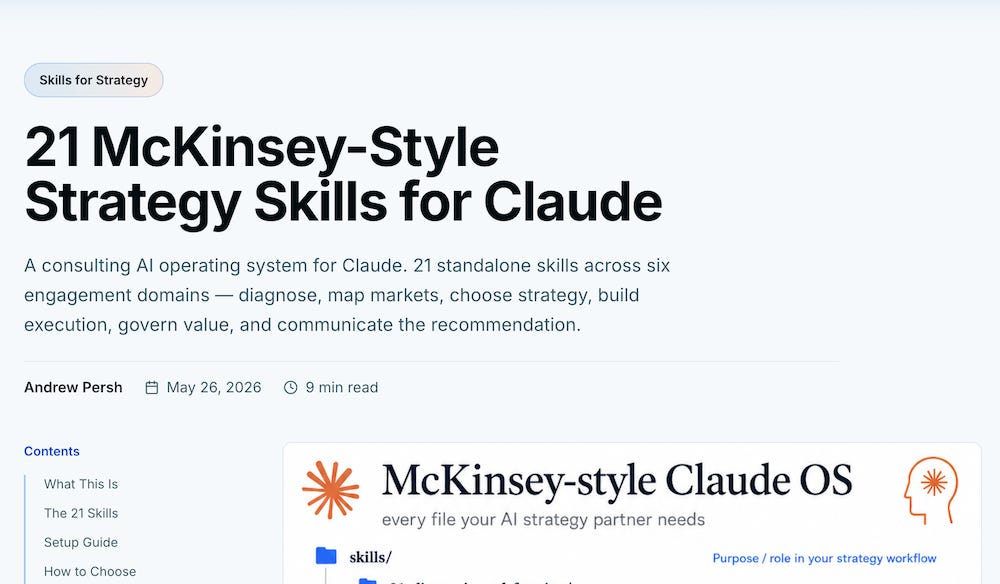
I’ve been creating and using Claude Skills (modular capabilities and instructions that Claude loads automatically when triggered by a keyword) quite extensively. It’s a brilliant feature. I can’t vouch for how good these are yet but these ‘McKinsey-style’ Skills look well organised and comprehensive and are easy to download and apply, giving you a whole repository of mini-automations to augment any strategic process. There was a good tip here as well, about adding in a ‘team lead’ that can orchestrate and pull in the relevant Skills in the order that will best help you address your challenge.
Weeknotes
This week I ran another AI in strategy course for the IPA, and ran a session with the leadership team of a big creative agency to help them with their positioning. Next week I’m out in the Middle East again working with my banking client out there, and I’ll be on the road again for the next couple of weeks.
Thanks for subscribing to and reading Only Dead Fish. It means a lot. This newsletter is 100% free to read so if you liked this edition please do like, share and pass it on.
If you’d like more from me my blog is over here and my personal site is here, and do get in touch if you’d like me to give a talk to your team or talk about working together.
My favourite quote is from the renowned Creative Director Paul Arden: ‘Do not covet your ideas. Give away all you know, and more will come back to you’. This captures what I try to do every day.
Only dead fish swim with the stream.