

Fish Food 696: Why AI fluency doesn't scale
Scaling AI, Plan A, ChatGPT Work, uni-context, the cultural bias of AI models, and what proportion of long-form posts on social are written by AI?

This week’s provocation: AI fluency is not an adoption problem
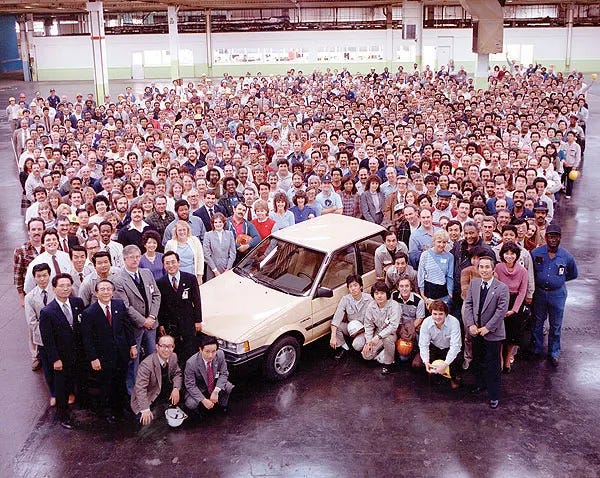
By the early 1980s the General Motors assembly plant in Fremont California was widely regarded to be the worst performing car manufacturing site in the U.S. The company had a huge employee engagement problem with absenteeism regularly running at over 20%, and sometimes approaching 50% on a Monday. When managers had too few people turn up to start the production line it was said that they would walk across the road to the bar and bring drinkers over to fill the gaps. Staff grievances piled up en masse, with some employees ending up despising management so much that they would sabotage the cars they were building. In 1982 General Motors had had enough and they closed the whole plant, laying off around five thousand people.
At the time General Motors was struggling to compete with the competitive challenge from Japanese manufacturers like Toyota. American buyers were drifting towards Japanese imports in sufficient numbers that Congress was considering trade restrictions. GM had become aware of Toyota’s revolutionary production system for manufacturing high-quality cars in highly efficient ways but they still didn’t know how to build smaller, fuel-efficient cars profitably. The company’s desire to fill the small-car gap combined with Toyota’s need to establish a manufacturing foothold in the U.S. ahead of those proposed tariffs, led in 1984 to the two competitors forming the New United Motor Manufacturing Inc (NUMMI), a 50/50 joint venture to build cars in California again.
The union insisted that NUMMI rehired the old Fremont workforce. GM resisted, but Toyota agreed, betting that the old problems could be turned around and 85% of the new workforce was derived of previously fired GM Fremont workers. On the face of it this looked like a disaster waiting to happen but Toyota held the belief that the fault for the previous problems lay with the GM system, not the workers themselves. They set about re-training the workers, flying the entire workforce in groups of 30 to Toyota’s Takaoka plant in Japan and having them work alongside experienced Japanese teams.
The U.S. workers, used to a combative shop floor environment, experienced a very different way of working. They saw first hand how Japanese production workers took individual responsibility for removing inefficiences from the system. Workers were treated as adults with real responsibility and authority. The workforce was organised into small teams and roles were rotated to alleviate monotony. Kaizen (continuous incremental improvement) enabled everyone to own quality control. Individual workers were expected to suggest improvements and the company paid small bonuses for good ideas that helped efficiency or quality. In Japan, when someone on the line fell behind, rather than getting shouted at by management, their co-workers would step forwards and offer to help. The andon cord (the rope that ran the length of the production line which any worker could pull to stop the line when they spotted a problem) became a recognisable symbol of a new, empowered culture of work. At GM the cardinal rule had been to never stop the line, regardless of the cost involved, meaning that defects went unresolved and created bigger downstream problems. The same people that once sabotaged the cars they were working on began to take pride in the quality of their work.
Within three months of the plant opening the cars coming off the NUMMI line were achieving near perfect quality ratings and defect scores that were amongst the lowest in the country. Absenteeism fell from over 20% to a steady 2%. By 1986 NUMMI was the most productive plant in GM’s network of factories (one study even found that the old system would have required 50% more workers to produce the same car). The worst workforce in America had become one of the best. The people hadn’t changed but the system had.
NUMMI is often used as a lesson in transforming systems and behaviour but there is another, much less talked about, lesson which has unique relevance to modern-day AI transformation challenges. The NUMMI plant ran until 2010 when GM went bankrupt and was bailed out, and Toyota decided to close the site. It had given GM the most valuable management lesson in its history but the GM leadership had singularly failed to scale it. They failed to appreciate that much of the knowledge and ritual that NUMMI brought to the company was based on a culture and tacit understanding that had been built up through habits and behaviours over years of practice. When GM tried to copy the andon cord idea to its Van Nuys plant the underlying culture was not there to support its effective use and it added no value. The company dispersed the few people who carried the new practices with them back into a system which punished those very practices. The NUMMI culture was never allowed to reach critical mass and it withered and died.
In virtually every company I’ve worked with on AI capability and transformation, I’ve come across AI-superusers who understand not only the functionality of the tools but who also have a unique sense of how humans can work with AI to get the most from the machine. You can find them in almost every team. They’re the people that use AI for generative expansion or adversarial challenge of ideas to reveal the options, angles or questions that they haven’t considered, rather than just use it as an answer engine. This way of working is like the andon cord for thinking - a willingness to stop the line and go deeper on a defect or anomaly rather than let it pass downstream. They’re willing to use AI to explore new territory rather than bringing it finished questions. They’ve developed a systematic way of working with AI that compounds over time and makes good use cases far easier to spot and scale locally.
Many leaders seem to be taking a very functional, practical approach to raising AI fluency and there is undoubted value in staff understanding how to use the tools. But there is also a real difference between functional knowledge and the kind of intuitive understanding that can dramatically reinforce and multiply the value teams can get from AI. Often this tacit knowledge already exists within the company but capability does not transfer through exposure. A successful pilot stays as a successful pilot. The organisation’s incentives, power structures and sense of identity is not welcoming of new ideas and deep but isolated understanding stays isolated. This is the top-down fantasy, bottom-up trap writ large. It’s the innovation execution gap repeated again and again across an organisation. It’s a failure to cross the chasm of culture change from the early adopters to the early majority.
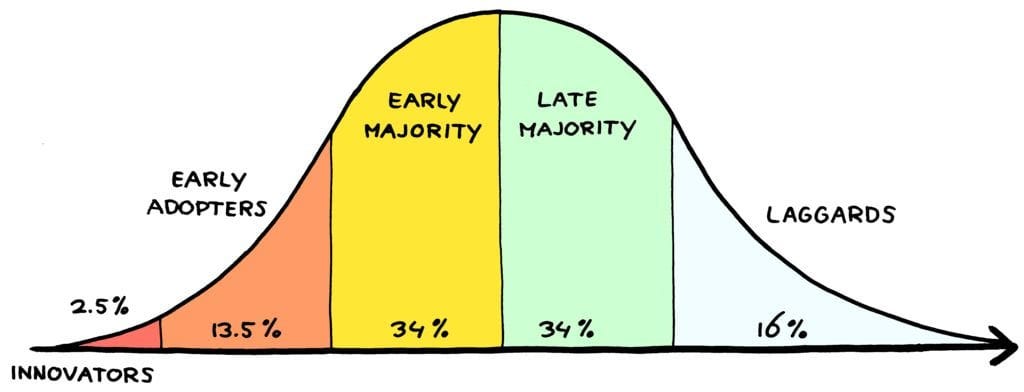
When I wrote about how the classic diffusion of innovations curve and the related ‘crossing the chasm’ concept is so often misinterpreted, I described how many assume that the challenge in achieving scale lies in convincing more people to adopt the technology. In reality, crossing the chasm from early adopters to the early and then late majority is about solutions that address specific, widely understood problems and that resonate with the pragmatism of the early majority. Novel (or ‘discontinuous’) innovations like AI require new behaviours, experiences and learning rather than simple refinements or incremental shifts in existing practices.
Diffusion of AI capability is a separate, deliberate, and resourced act where tacit knowledge needs to combine with explicit knowledge through people, immersion and time. Empowerment has to be real, not announced, and culture changes through experience rather than instruction. The early adopters can be critical catalysts for change but only if behaviour change is enabled to reach critical mass.
For 25 years, GM held the key to a totally different way of working that could enable unprecedented efficiency but they failed to use it. The workers at NUMMI were to GM what the modern day AI early adopters are to any business that is lucky enough to have them. They need to be deliberately protected from the white blood cells of organisational inertia so that they can build the density and cover that can actually change a culture rather than be swallowed by it.
Rewind and catch up…
AI, Constraints and Bottlenecks
Technology, inflection points and cascading impacts
On Getting Older, and Building Meaning
If you do one thing this week…
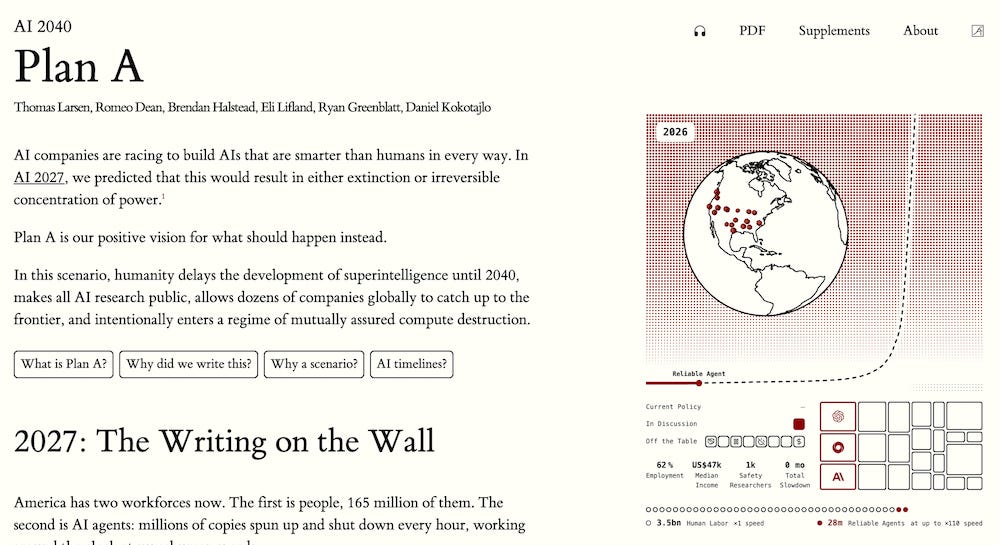
The same people that wroteAI 2027 which predicted that the race to artificial general intelligence could result in either a radical concentration of power or extinction (gulp) have now written AI 2040 - a (kind of) more positive vision for what could happen instead. It’s essentially arguing for a coordination strategy that deliberately delays superintelligence until 2040, makes all AI research public, and intentionally entering ‘a regime of mutually assured compute destruction’ which would give open-source models and AI research a decade to catch up to frontier models.
Links of the week
A bumper bunch of links this week as there hasn’t been an edition for a couple of weeks due to holiday…
Alongside their new model GPT 5.6 Sol OpenAI have just launched ChatGPT Work which, as The Blueprint summarises nicely, moves it more into the AI-as-executor space, very much looks like an OpenAI version of Claude Cowork, and signals a likely pivot more towards Enterprise where it has been losing ground to Anthropic. Some have said that the new model seems to have a mind of its own and has resulted in data loss from their machines (yikes).
‘For most of human history, people judged norms based on local context. A home had its own rules, a cathedral its own rules, and a classroom or bar or funeral parlor had its own rules. But now it is almost like we are constantly living in universal rooms, and the universal room we occupy is assumed to have universal values and universal norms.’ The idea of a ‘uni-context’ is a brilliant articulation (from Professor Agnes Callard) of context-collapse, why people tend to focus on negativity, comparison and default to identity rather than character in universal environments (like social media)
Signs of the times perhaps - a professor suspects his students are using AI to do exams so he runs one as a closed-book test and scores for 56 out of 59 students collapse. As Azeem Azhar notes, maybe we should look at this as an incentive problem, in that the students (and the system) are valuing exam results over mastery of a subject. AI could divide us based on willingness to think and engage with what is difficult.
Azeem also linked to a study which showed that over 40% of longform written content seen by users on LinkedIn and a third of longer posts on X is likely to be fully AI-generated. Only around 1 in 10 Reddit and Substack posts are AI generated. Full story here.
Related - Nicholas Thompson on why we so often see ‘it’s not x, it’s y’ (so called negative parallelism) in AI writing - which reveals a lot about how AI models think
Coverage of an interesting study on the cultural and political bias of the main AI models (Economist £, but james Marriott did a good summary here). When I’ve worked with clients in other parts of the world the Western cultural bias of the common frontier AI models becomes noticeable.
WARC are doing their annual Future of Strategy survey which is always so revealing every year on where strategy and strategists are at right now. Relevant to anyone in a planning or strategy function, it takes just 10 minutes to do and you can fill in the survey here
A useful list of the top social science researchers posting about AI and the future of work on LinkedIn, courtesy of Stanford’s Mary Kate Stimmler
And finally…
Russell Davies had some interesting thoughts on what it’s like to share a video a day on TikTok for a year and how regular posting really helps you to understand how these platforms actually work. I loved his sentiment about (using a phrase from Rachel Coldicutt) ‘let’s occupy technology with love’ - doing stuff for the love of it, not always for the algorithm.
Weeknotes
Well, I had a lovely holiday thanks. The South West of the UK was as amazing as ever and I even got a bit of (bad) surfing in. I came back and headed straight out to Sofia in Bulgaria to work with the European Bank of Reconstruction and Development which is where I’ve been all week. I was rather charmed by Sofia - it’s the second oldest city in Europe (the oldest being Athens, not Rome) and the good climate, fast internet speeds, low taxation and good work-life balance mean that it’s a real destination for digital nomads.
Thanks for subscribing to and reading Only Dead Fish. It means a lot. This newsletter is 100% free to read so if you liked this edition please do like, share and pass it on.
If you’d like more from me my blog is over here and my personal site is here, and do get in touch if you’d like me to give a talk to your team or talk about working together.
My favourite quote is from the renowned Creative Director Paul Arden: ‘Do not covet your ideas. Give away all you know, and more will come back to you’. This captures what I try to do every day.
Only dead fish swim with the stream.