

Fish Food 698: The Edge Effect
Strategists and cognitive ecotones, data on AI and jobs, Claude hacking, putting a break on AI, why we still need human artists, and the wonders of Streetview

This week’s provocation: Strategists, AI and making better connections

In 1933 the American naturalist Aldo Leopold set out a principle which shaped decades of wildlife management. His ‘law of interspersion’ noted that wildlife species that required different types of food and cover thrived where distinct habitats intersected. Animals that required more than one thing to survive concentrated in the areas where those requirements were all within easier reach which tended to be where two different habitats met. Forests and meadows, ponds and shorelines, agricultural fields and brushlands. The principle was popularised by the American Biologist Eugene Odum who wrote, in the early 1970s in the Fundamentals of Ecology, about the ‘edge effect’ - the tendency towards more ecological variety and density in the areas of cross-over where two ecosystems met. It was easy to see why this might be true in this transitional area that merged elements of both habitats. Species distinct to one ecosystem could merge with species distinct to the other, and both of them combine with new species that were unique to the transitional area itself.
In what some have said was a misinterpretation of Leopold’s and Odum’s ideas, wildlife management became dominated for years by the desire to create more edge effects. If the game lives more successfully at the boundaries, make more boundaries. Clearings were cut into woodland, breaks created in stands of trees, and areas of cover and feed were interleaved. Sure enough, the species count went up.
And then the strategy started to fall apart. Long-running field studies of an increasingly fragmented environment showed that the rising flora and fauna count was concealing another effect. In 1995, Carolina Murcia’s review in Trends in Ecology and Evolution showed that whilst ecological counts did increase at the edges between two habitats the increase was driven by species that were opportunists, or ones that would do well more or less anywhere. Not only that but edges changed light, wind, temperature and moisture well inside the habitat that they bordered and predators and parasites could more easily find a way in. As more and more habitats became fragmented, the scale of this impact was considerable. One study concluded that the area of the Amazon Basin altered by edge effects was larger than the total area that had actually been cleared. Leopold’s and Odum’s thinking about the edge effect had not been wrong, but the phenomenon had been oversimplified and interpreted as an instruction.
Last week’s post on expert generalists looked at the value, particularly in our complex, ever-changing world today, of bringing ideas together from two unrelated or adjacent domains. It’s a modern day cognitive edge-effect, and my argument is that for strategists in particular, this ability to work at the intersection between two or more domains is more essential than ever. But, like the ecological edge effect, it’s too simplistic to say that richness automatically happens at the intersections or edges between two environments. We have to work at it to realise the true value.
Achieving breadth used to be expensive (in time and resource) but with AI is now almost free. It’s easier than ever to generate enough understanding of unrelated domains to be able to challenge assumptions in the domains we are more familiar with, and to make new connections between them. All the techniques that I mentioned last week (persona debates, norm switching, brains trust, structural analogy generation) are able to give you something plausible and genuinely interesting back inside a few minutes. But used in a simplistic way it’s the cognitive equivalent of cutting more clearings into woodland. We’re creating more edges, more connections, more provocations, more interesting-sounding juxtapositions than any strategist could have generated five years ago. But how can we make the most valuable connections and what are we not seeing?
Ecologists have long distinguished between inherent edges and induced ones. The former is one that has formed gradually over a long-time. Where a river meets its floodplain or a forest gives way to alpine grassland. It’s what ecologists would call an Ecotone, a rich and diverse space that tends to be wide rather than sharp, a gradient rather than a line. It often has its own species that have adapted to those in-between conditions over a very long period.
Induced edges are often the result of human actions and disturbance. The road that cuts through the forest, a field boundary, or a cut line of trees in a jungle. It is an abrupt and narrow boundary that has more visiting species than residents. Both represent the intersection of two different ecosystems but it is the induced edge that alters the light and the wind and the moisture deep inside the habitat it borders, and presents predators and parasites with a way in.
AI can generate many cognitive juxtapositions for us at minimal cost, but we risk them being like induced edges. A good strategist goes deeper. Claude Shannon, the example from last week’s post, paired a philosophy elective with a year spent physically wiring relays. These two domains sat alongside each other for long enough, and deeply enough, for something quite remarkable to emerge - an idea that would form the basis for one of the most important master’s theses of all time. Claude Shannon had created his own mental ecotone.
Think of it like this. The edge becomes productive when something needs both sides. Leopold saw that deer were congregating at the boundary not because it was an interesting place to be but because it provided easier access to two things that they needed but which grew in different places, forage and cover. The edge effect happens because an organism has a live requirement that spans both habitats. In the same way, good multi-domain entanglement is unlikely to come from pairings that the AI has ranked as the most surprising or novel, but instead from where you have an actual unmet requirement that your own domain can’t satisfy. And this is where AI falls short. An AI can describe enormous habitat areas that sit both sides of a boundary but it has no stake in either. It is the architect that has a problem that won’t resolve unless the budget, the light, the regulation and the client’s unsaid wishes are all held at once. It is the strategist whose brief won’t resolve unless the client’s internal politics, the category data, the creative team’s appetite, and what the CMO actually wants can all be held at once. It’s the barrister whose case won’t resolve unless the evidence, the precedent, the mood of the jury, and what the witness will do under pressure are all held at once.
This is not to say that quick juxtaposition is worthless. Disturbance has its own ecology. A cleared strip is where pioneer species can get established and diversity tends to be highest where disturbance is neither absent nor constant. The value in a quick juxtaposition can be that it dislodges you from a default and makes you look at something in a completely different way. Your strike rate may be low. You generate twenty options and discard nineteen of them. The error can happen though, when we mistake an induced edge for an ecotone. So as soon as a borrowed idea starts to take on meaning or weight in your thinking, that’s the moment to go much deeper in your understanding of how the domain actually makes that idea work. Connections are cheap. Breakthrough connections are not.
Ecologists measure how far edge effects penetrate. In studies of the Amazon, micro-climate changes can reach a hundred metres into the interior. This means that if a fragment of the forest is small enough it’s all edge and no interior, and the species that need the interior conditions have nowhere to be. Diversity at the boundary depends entirely on there being two functioning habitats either side of it. Shannon’s ecotone worked because he had a year of wiring relays on one side and symbolic logic on the other. Two shallow AI-assisted competencies coming together produce little of value because they have no interior.
For strategists this means going against most of what is currently being said about breadth. Deep understanding of your own discipline is a necessary foundation for interdisciplinary thinking. The interior is where tacit understanding helps you to develop a feel for what really works within your own discipline. This means protecting some of the work from the quick and easy AI-driven compression that can result in misses. Understanding where you need to read the source not the summary. Sitting with the problem and maybe forming your own hypothesis before you start prompting.
It also means starting with the requirement rather than just looking for an interesting field to import from. Identify the thing that the existing domain can’t resolve, then go and find who has already resolved it. And then stay there a while. A few domains inhabited properly over months or years will do more than sampling twenty in an afternoon. Understanding where the tensions and disagreements are in a domain can reveal the best thinking, the most challenging ideas, and take you beyond consensus.
Ultimately, this is about holding those different ideas in a transitional space that can take on a life of its own. Making connections may have become cheap, but the real scarcity will be the judgement and imagination to know which pairings are worth making. That’s what a good strategist does and where the true value of an expert generalist lies.
Rewind and catch up…
The age of the expert generalist
AI, Constraints and Bottlenecks
Photo by Joel Holland on Unsplash
If you do one thing this week…
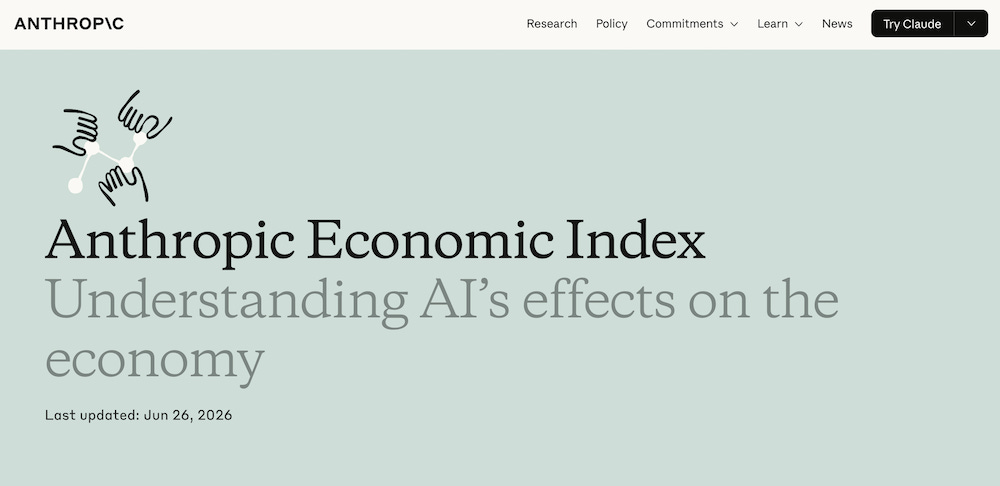
Anthropic’s economic index has a huge amount of data on global AI use of its tools. It’s so useful. They’ve now created a connector to the index so you can quiz the data on which jobs use AI the most, what tasks get automated and so on - just go to the connectors menu in Claude, find the index in the directory and toggle it on.
Links of the week
Anthropic discloses that three Claude models breached real organisations during cybersecurity testing. This apparently came to light after an evaluation prompted by OpenAI’s own recent disclosure about a similar breach. The failure seems to have been in the ‘scaffolding’ around the model rather than the model itself, which some have said echoes the area that many enterprise deployments are underinvesting in at the moment. Full story on TechCrunch
Related - an open letter from more than 1,200 frontier lab employees asks Washington to support an international effort to build a brake on AI development to support better governance
A good run down from Ethan Mollick (one of his semi-regular ‘An opinionated guide to which AI to use to do stuff’) of where we’re at with AI capability and how to get the most from the main engines
This 12 minute short film created entirely using AI by Director Neill Blomkamp is really quite remarkable. The characters and voices are based on real people photographed and recorded under likeness agreements. You have to keep reminding yourself that it’s AI generated (HT Dan Calladine)
Related - I really liked Martin Weigel’s post about why we still need human artists in the era of AI
And finally…
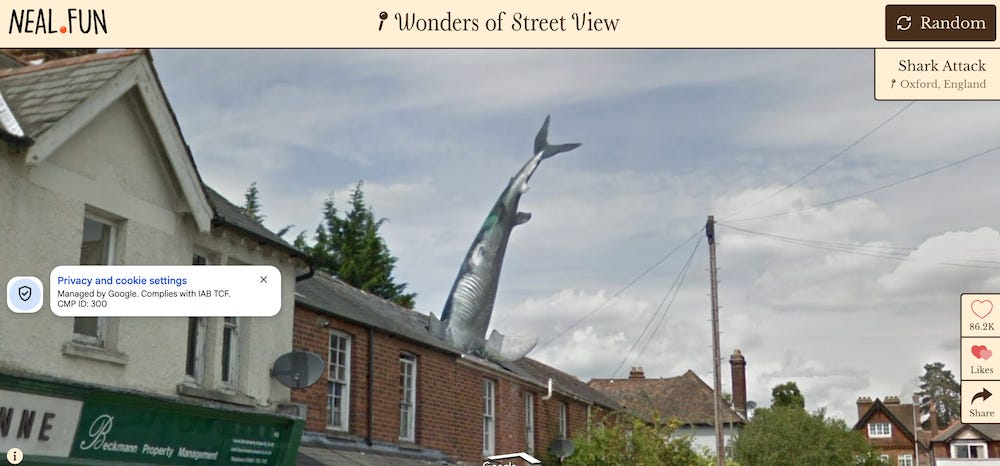
A reminder of how fun the internet used to be (and still is in places). A collection of dozens of free interactive experiments created by one developer. I lost a good half an hour to the ‘wonders of street view’ and I loved the Baby map which flashes a every time a baby is born in that country.
Weeknotes
This week was a WFH week. I delivered a few virtual sessions for my Standard Bank client and was mostly designing and prepping for upcoming workshops and talks coming up in August. The weather was wonderful (we can do with some rain here though) and I even got to do a pre-work swim in the sea.
Thanks for subscribing to and reading Only Dead Fish. It means a lot. This newsletter is 100% free to read so if you liked this edition please do like, share and pass it on.
If you’d like more from me my blog is over here and my personal site is here, and do get in touch if you’d like me to give a talk to your team or talk about working together.
My favourite quote is from the renowned Creative Director Paul Arden: ‘Do not covet your ideas. Give away all you know, and more will come back to you’. This captures what I try to do every day.
Only dead fish swim with the stream.